

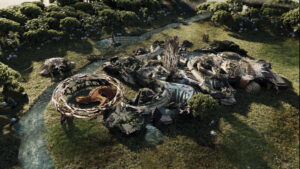
Lucia Landivar’s thesis, “Architecture / Nature – A Hybrid,” presents a revolutionary approach to architectural design, merging natural elements with modern construction methods. This concept is demonstrated through a detailed exploration of sustainable materials and innovative structural solutions that integrate the natural environment into urban settings. Lucia emphasizes the use of bioplastics, bamboo, and mycelium-based concrete to reduce the ecological footprint of buildings while enhancing their aesthetic and functional qualities. Her work challenges traditional architectural paradigms by proposing designs that are both environmentally responsible and adaptable to changing urban landscapes, advocating for a future where architecture and nature coexist harmoniously.
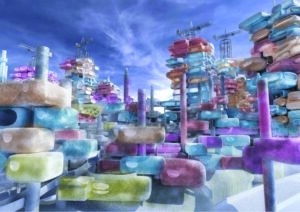
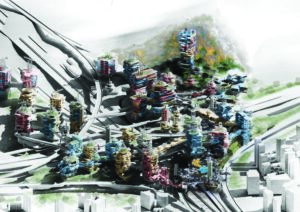
Amid rising political and environmental instability, we need resilient structures that adapt to changing circumstances such as pandemics, extreme weather, and shifting aesthetic trends, without gentrifying existing areas. As climate change renders rural regions less habitable, pushing populations towards cities, Los Angeles is projected to densify significantly. By 2070, its population could reach around 26 million, leading to the formation of high-density sub-centers within the metropolitan area. I envision AI-managed structures that develop a form of consciousness, enabling rapid adaptation based on real-time data. These self-sustaining habitats, complete with automated factories and distribution systems, can expand, contract, and repurpose themselves as necessary, efficiently utilizing available space.
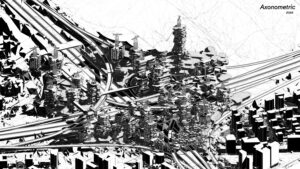
The instinct of the individual is an inseparable aspect of each of us. This aspect of our beings, sometimes considered a defect, conditions and directs our activities. It is such notions that distinguish us from the machine.
Since the 1990s, the advent of the internet and the automation of certain tasks by technology have improved our daily lives but also dehumanized and increasingly fragmented our relationship with others. The globalization of resources, technologies and labor is becoming more and more embedded in our systems of societies wherever we are. Exchanges, faster, information, instantaneous.
-Hasn’t the city become a monster-machine?, always eager for maintenance, improvements, resources and manpower?
In a way, would we no longer live for city systems, rather than through them?
The observation of our ways of living in this extremely complex environment system, brings to light a fundamental and haunting question: What is the part of the instinct of the individual in the course of the city?
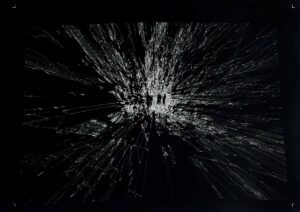
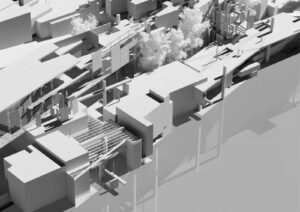
Through nonsense abstract mechanics, I confront reality with questions about the qualification and identity of today’s space by giving free rein to the appropriation of space and its function.
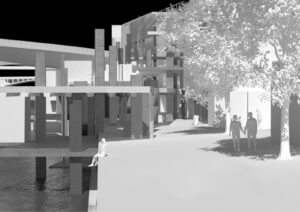
In March 2022, Confluence Institute and the Kharkiv School of Architecture were going to organize a joint workshop…
We support our friends from Kharkiv and Ukraine and pass on the words of Oleg Drozdov, founder of the architectural bureau Drozdov&Partners and co-founder of the Kharkiv School of Architecture:
“My dear foreign friends. Thank you very much for your support. We need your help. You can convince your governments to close the skies over Ukraine by organizing mass protests in your states. We would be grateful if you could support our army by donating it. . Our army fights for our and your freedom”.
https://www.facebook.com/100007928224644/posts/3158442851096625/?d=n
Confluence Institute Fall 2021 Lecture series
November 2, 2021
The gap in architecture between socially centered practice and formally exploratory practice remains, and perhaps is widening. Why are these forms of practice seen as opposed or even mutually exclusive in architecture? Is it possible to design a way of working that engages both areas simultaneously? Moreover, there has not been enough attention given to materiality as a deeply philosophical, inherently social, and formally generative territory for architectural exploration. Material generators can become potential stepping stones along a spectrum of formal and social architecture and help determine the position and self-understanding of the architect. This talk by American architect and Harvard GSD Professor of Practice Jeanne Gang will explore key projects in her practice, Studio Gang, ranging from small community centers and civic buildings to large public parks and museums that share a concern for materiality as a way to engage both social and formal aspects of architecture.
FAIA, est le partenaire fondateur de Studio Gang, un cabinet international d’architecture et de design urbain dont le siège est à Chicago avec des bureaux à Paris, New York et San Francisco. Reconnue pour son approche distinctive qui dépasse les frontières conventionnelles de l’architecture, elle crée des lieux saisissants qui relient les gens à leurs communautés et à l’environnement naturel. Son portefeuille diversifié à travers les Amériques et l’Europe comprend une extension Musée américain d’histoire naturelle; ambassade des États-Unis au Brésil ; et le nouveau Centre de l’Université de Chicago à Paris. Boursière MacArthur et professeure en pratique à la Harvard Graduate School of Design, Jeanne a été nommée l’une des personnes les plus influentes au monde par TIME Magazine. L’édition française de la monographie de son studio, Studio Gang : Architecture, a été publiée cette année.
Life can be easy. We go to school, we study architecture (or whatever crap), we work in an office, we open our own office, we build houses. We get married, start a family and live in our own house. Somehow nice but bourgeois and unrealistic! Life changes. We live in a complex world. Humanity faces great challenges: climate change, unequal distribution of wealth, social division, inequalities and political emergencies, uncertain futures, economic transformations and social changes. Politics is overwhelmed and the narrative of the future has seemingly been abolished. Act instead of react! Can architecture help us?
Benedikt Hartl est un architecte allemand. Ses projets étudient la relation complexe entre l’architecture et les processus d’émancipation socio-politique. Au cours des dernières années, son travail a reçu une large reconnaissance internationale avec des publications dans plus de 100 pays. Il expose et donne des conférences tant au niveau national qu’international.
Bureau d’en face est un studio d’architecture primé à Munich, en Allemagne. Il a été fondée en 2017 par Benedikt Hartl. Opposite Office dessine, écrit, imagine et construit des histoires architecturales. En créant des solutions spatiales aux problèmes sociaux et politiques, Opposite Office s’engage dans les champs de l’architecture, de la société et de ses interfaces. Leurs projets traversent les registres théoriques et militants pour créer de nouvelles formes de travail architectural par des interventions critiques. Opposite Office travaille à travers l’architecture et son refus. La pratique spatiale militante est fondée sur la recherche de contextes publics, culturels et politiques. L’œuvre se niche entre réalité et fiction. Opposite Office cherche à réimaginer et à repenser l’architecture dans le cadre de sa mission sociale et spatiale. La pratique engagée politiquement et socialement, contribue aux questionnements et enjeux de société. Le travail a été publié et largement exposé dans plus de 100 pays.
There are many examples of experimental architecture, but it is the city itself that we most yearn to change. Yet, despite its dysfunctions, the city evolves very slowly. It is a meme that got stuck and continues to exert its fascination. The changes that do take place occur unintentionally. Like mutations in nature, they happen by chance, accidentally., outside the realm of volition. The internal combustion engine, the human invention that has had the greatest impact on forming the contemporary city and making it what it is, both suburbia and skyscrapers, was certainly not created with the deliberate intention of reshaping the world we live in. This was an accidental by-product. The giraffe does not have a long neck because it decided to, but because of chance mutations that proved to be helpful for reaching high leaves. Are such radical mutations already taking place in the city? If so, how can we identify them and possibly facilitate them?
Educated at the Architectural Association (AA) London, from which he graduated in 1969 (AA Dipl. Hons), where he was Diploma School Unit Master from 1970 to 1974. He is Emeritus Professor of Architecture and Urbanism at the Bartlett School of Architecture, University College London (UCL), where he was Director of Diploma Unit 18 and of the Master of Architecture course in Urban Design. He was visiting Professor at the University of Innsbruck (Studio 3 for experimental architecture), the Chinese University of Hong Kong (CUHK), the National University of Singapore (NUS), the University of Auckland, etc.
He was an associate of Archigram Architects in London and Planning Director of the Ralph M. Parsons Company in Pasadena, California, USA, responsible for major planning projects in the Middle East, in particular the new town of Yanbu in Saudi Arabia. He was Bernard Tschumi’s partner on the Parc de la Villette project in Paris and co-author, with Sir Peter Cook, of the Graz Kunsthaus, a contemporary art museum in Austria (2003). His “Open Cinema” project was realised in Guimarães, Portugal (2012), Lisbon (2013) and Hong Kong (2016).
He was Chief Curator of the 2013-2014 Urbanism and Architecture Bi-city Biennale for Hong Kong and Shenzhen (UABB*HK), responsible for the Hong Kong section of the Biennale, for which he chose the theme of “The ideal city”. He was approached by the Shenzhen side of the same Biennale as a curator for 2020-2021, with the theme of “The uncertain city”, aborted due to Covid 19.
He is a founding member of The Daylight Academy (DLA), based in Zürich, and currently engaged in a research project on chronobiology, circadian rhythms and daylight in architecture.
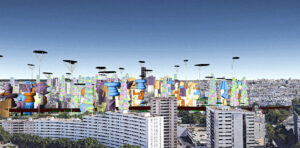
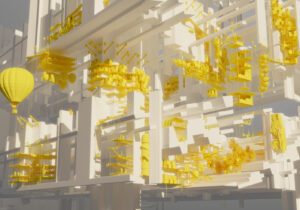
The role of the architect would be, in this scenario, to design the skeleton or masterplan. Every architectural element in the scene is simply a bounding geometry or volume. It can be broken down into points. The objects that would populate these points would be designed by the people or a group of people from the community. This could be done by hand, through software, or in realtime using thoughts and emotions through a Brain-Computer Interface. The result is a collage of objects uniting to create the final product. The software helps organize the pieces, create connections, orient them, and connect systems in an environmentally friendly way.
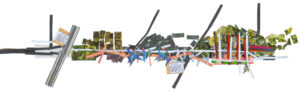
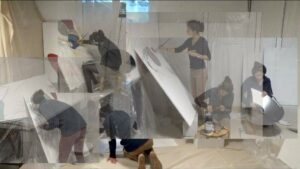
Jhila Prentis examines the issue of migration and its impacts on societies and individuals. Through a series of reflections and examples, the author discusses the challenges faced by refugees and asylum seekers, including administrative difficulties in France and precarious living conditions in camps. It highlights feelings of sadness and injustice experienced in response to migrants’ distress. Jhila Prentis criticizes the inadequate and often inhumane responses of host societies, while calling for awareness and a radical change in the approach to migration and integration.
On the occasion of our the spring semester devoted to the exploration of the Sea, Jacques Rougerie will meet with the the students of Confluence and address the challenges of this fascinating liquid territory.
You’re welcome to follow the lecture online : https://zoom.us/j/91786815829
JACQUES ROUGERIE
Visionary architect, Member of the Institute is passionate about the sea and space. He has based his research and achievements for more than 30 years on a bionic architecture based on biomimicry, a real bridge between living forms and built forms, taking into account in particular the precepts of sustainable development.
His forward-looking vision and his taste for new technologies allow him to offer a better integration of the habitat into the natural environment, especially marine, so that the people who live there can join.
In this sense he draws his inspiration both from the legacy of Leonardo da Vinci and from his faith in human genius. In this spirit, he built underwater habitats, vessels with transparent hulls, underwater museums, sea, scientific, technical and cultural centers, sports and leisure facilities, hotels, and airport and industrial facilities. in France and internationally. He thus brings together his passions, the sea, space and biomimetic architecture.
Experiencing his own achievements as a true explorer of the underwater world, he has gone so far as to live several times in underwater habitats, notably participating in the world record for 69 days under the sea in the United States. Its projects, SeaOrbiter and the Cité des Mériens, are the synthesis of more than 30 years of innovative research in the fields of marine and underwater architecture.
Also always inspired by the work of Jules Verne, he adopted the maxim: “Whatever a man is able to imagine, other men will be able to achieve it”. To transmit his passions and encourage young people at the international level to be daring to build our future, he created the Jacques Rougerie Foundation, Génération Espace Mer at the Institut de France.
“It is from the ocean and space that the fate of future civilizations will be born”
Odile Decq is the guest of the tenth episode of the Hors concours podcast. An opportunity for the architect to review the significant developments of the past 30 years and to share his vision of education and the place of women in architecture.
An hour of relaxed conversation to give voice to one of those who make the city today. Each month, in this podcast, an architect tells his story through his journey, his work and his vision of architecture.
We carry with us the memory of Mary Vaughan Jonhson, friend and regular visiting-professor of Confluence. Mary joined our adventure since its beginning in 2014 and was a strong and joyful support of our school. All our thoughts goes to her family and to all the students that had the chance to meet her contagious enthusiasm.
Confluence Institute is proud to share its Spring 2021 Inaugural lecture that took place on Tuesday March 2nd, 2021.
How to join CONFLUENCE ?
CONFLUENCE has its own recruitment process outside of “Parcours sup”, the national education platform. Confluence therefore autonomously manages the admission schedule and the selection of students.
The timetable of the procedure is published at the beginning of the semester for the following semester.
CONFLUENCE is one of the only school of architecture to offer two entries a year, one in autumn, beginning of September, and one in spring, beginning of February.
What are the selection criteria to join CONFLUENCE?
The selection to join Confluence Institute is based on file (letter of motivation, CV …), portfolio and video in which the candidate presents itself and exposes its motivations.
Unlike traditional French schools, Confluence does not conduct individual interviews to allow foreign students to apply on the same basis as French students.
In case of doubt from the school, a direct interview may be requested.
71% of our planet is Ocean.
It represents 361 Million km2 and contains 1,33 Billion m3 of water. It is regulating climate on Earth. Without it the temperature of the atmosphere would be 35° higher
The human body is made of 70% of water and the composition of its plasma is very close to the composition of the sea. The Ocean provides all the water humans are drinking, half of their oxygen and one fifth of their proteins.
For a long time, the economic, politic, social and cultural power was in the hands of those who mastered the Ocean. By controlling the oceans, Empires were controlling the world from their harbors and gave birth to great civilizations (Venetian, Flemish, Genoese, Dutch, English, American, Chinese) and their cities whether they be real, legendary or submerged.
Moreover, most of the innovations mainly came from the sea, whether it be ideas or goods. Today, as nine out of ten goods, communication or data travels through the Ocean, it has become, more than ever, the place of the geopolitical debate.
Indeed, till today, more than 50% of humanity is living on the 100km wide frontier between oceans and inner lands. How will these human settlements face the rise of the sea level and the profound transformation of the ocean coasts?
Furthermore, the climate change and the continuous population growth will inevitably force us to change or relationship with this unknown liquid continent. It is already facing major climate and political challenges and will undoubtedly play an important role in the survival of humanity.
With the collaboration of Odile Decq, Nicolas Hannequin, Jieun Kim, Nicolas Floch’, Didier Faustino, Marc Van Peteghem, Jacques Rougerie, Christian Buchet, Bruno Dehan and Gaetan Kohler, the students of Confluence will spend the Spring semester working and researching on this new territory: Going in, travelling on, living in, over and inside, protecting it, establishing new settlements…
Confluence Institute is happy to present the publication of our close friends and professors Aaron Sprecher and Chandler Ahrens. The book explores our post-digital culture to better understand its impact on theoretical discourse and design processes in architecture.
With the contribution of : Georges Teyssot, Antoine Picon, Mark Linder, Dana Cupkova, David Freeland and Brennan Buck, Viola Ago, John Carpenter, Nicholas de Monchaux, Martin Bressani, Volkan Alkanoglu, Thom Mayne, Alvin Huang, Pablo Lorenzo-Eiroa, Alessandra Ponte, Laurent Stalder, Satoru Sugihara, Greg Lynn, Tom Shaked and Uri Dublin, Jose Sanchez, and Theodora Vardouli.
Confluence Institute hosted a series of online lectures during the first lockdown of 2020. Here is the link to the event that took place on Wednesday May 17th, 2020.
Antoine Picon is the G. Ware Travelstead Professor of the History of Architecture and Technology at the GSD. He teaches courses in the history and theory of architecture and technology. Trained as an engineer, architect, and historian, Picon works on the history of architectural and urban technologies from the eighteenth century to the present. His French Architects and Engineers in the Age of Enlightenment (1988; English translation, 1992) is a synthetic study of the disciplinary “deep structures” of architecture, garden design, and engineering in the eighteenth century, and their transformations as new issues of territorial management and infrastructure-systems planning were confronted. Whereas Claude Perrault (1613-1688) ou la Curiosité d’un classique (1988) traces the origin of these changes at the end of the seventeenth century, L’Invention de l’Ingénieur Moderne, L’Ecole des Ponts et Chaussées 1747-1851 (1992) envisages their full development from the mid-eighteenth century to the 1850s. Picon has also worked on the relations between society, technology and utopia. This is in particular the theme of Les Saint-Simoniens: Raison, Imaginaire, et Utopie (2002), a detailed study of the Saint-Simonian movement that played a seminal role in the emergence of industrial modernity. Picon’s most recent books offer a comprehensive overview of the changes brought by the computer and digital culture to the theory and practice of architecture as well as to the planning and experience of the city. He has published in particular Digital Culture in Architecture: An Introduction for the Design Profession (2010), Ornament: The Politics of Architecture and Subjectivity (2013), Smart Cities: Théorie et Critique d’un Idéal Autoréalisateur (2013), and Smart Cities: A Spatialised Intelligence (2015).
Picon has received a number of awards for his writings, including the Médaille de la Ville de Paris and twice the Prix du Livre d’Architecture de la Ville de Briey, a well as the Georges Sarton Medal of the University of Gand. In 2010, he was elected a member of the French Académie des Technologies. He is Chevalier des Arts et Lettres since 2014. He is also Chairman of the Fondation Le Corbusier.
Picon received science and engineering degrees from the Ecole Polytechnique and from the Ecole Nationale des Ponts et Chaussées, an architecture degree from the Ecole d’Architecture de Paris-Villemin, and a PhD in history from the Ecole des Hautes Etudes en Sciences Sociales.
The Biological Laboratory of Architecture and Sensitive Technologies [BLAST] is a group founded in 2018 with the aim of exploring the possible relationships between new technologies and living things in order to develop new processes of artistic and architectural creation. Digital design and manufacturing tools are at the heart of the studio’s experiments in design, scenography and architecture projects. Blast Studio develops a research to explore new ways to bring nature and technology into dialogue. Inspired by nature we created a new ecosystem in the city, where we recycle urban waste into outstanding sustainable objects and furniture thanks to living organisms.
Faced with the exponential volume of waste, these three architects have the idea of transforming it, using technology, in order to build responsibly and sustainably. The adventure begins in a kitchen, with the impression of mycelium using a 3D printer. In 2019, they acquire expertise in the Open Cell center during their stay in London, where they subsequently decide to set up their premises. The waste is crushed there, sterilized then mixed with fungi which digest their organic matter. Once in paste form, a 3D printer transforms them into a work of art, furniture or sustainable architecture. Their project in 2021 is to build a pavilion, the first step towards the dream of a city made of its own waste.
https://www.blast-studio.com
This week long event is the exhibition of a selected individual, young and promising, developing a discourse challenging our contemporary world.
Between Monday, 16th December 2019 and Thursday, 19th December 2019:
Sarah Lou Maarek, a young architect and artist, will occupy our exhibition space, located at the 11 rue des Arquebusiers, 75003, Paris.
Titled ‘From Furby with Love’ this Wild Card echoes Marshall McLuhan famous affirmation: “ We become what we behold. We shape our tools, and thereafter our tools shape us ”.
Using tools spanning from Visual Arts to Architecture, Sarah Lou Maarek is questioning the Y Generation relationship to Intelligent Machines.
In this exhibition, the Furby – a toy with which her generation grew up with – becomes symptomatic of our relation to the so-called smart objects and technologies.
She tries to answer the too often overlooked question:
“ Why do I sometimes speak to my computer ? ”.
While highlighting our trust in digital entities such as Alexa, Siri or Bixby, she questions our gaze on these personified technologies.
Who is the master ? Who is truly the slave ?
In a context by definition binary, she outlines a third option: the Doll, incarnation of all our digital fantasies and disorders. This – so far unachieved – entity inhabits a speculative world, oscillating between paradoxes: reality and fiction, dream and nightmare, subjection and emancipation, utopia and dystopia; rendering the possibility of a cohabitation between flesh and data, emotions and codes.
Join us at the 11 rue des Arquebusiers, 75003, Paris.
If our address changes:
Confluence Institute
11 rue des Arquebusiers
75003, Paris – France
Our commitment remains the same:
To further question the teaching of Architecture through an alternative pedagogy.
Don’t hesitate to follow our latest news and the daily lives of our students on Instagram and Facebook:
@confluence_institute
To contact us by email:
contact@confluence.eu
Or by phone:
+33 (0) 1 43 37 74 11